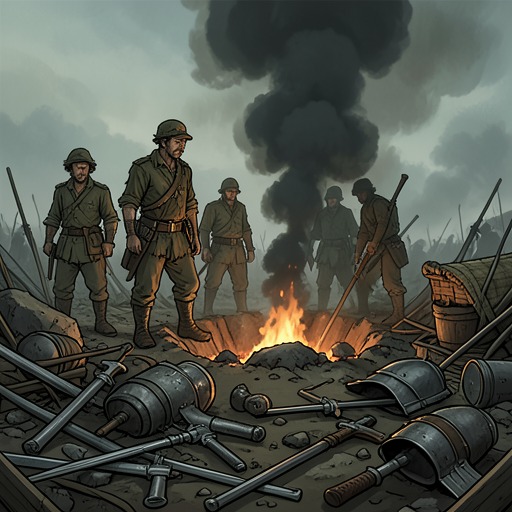
Peace is a beautiful gift for the future that was paid for yesterday with blood and sacrifice
Soul Guardian: A Hellishly Cozy Fantasy“Peace is a beautiful gift for the future that was paid for yesterday with blood and sacrifice” is a wartime expression of remembrance, responsibility, and guarded hope. In the exchange between Zephyr and Gabriel, it becomes more than a general ideal: it is Zephyr’s answer to a culture that treats conflict as inevitable and sacrifice as expendable. The phrase insists that peace is purchased by the dead, entrusted to the living, and judged by what the future does with that inheritance.
Meaning and Form
The expression begins by presenting peace as a “beautiful gift for the future.” Its imagery gives peace a direction in time. It is not primarily a reward enjoyed by those who fought, but something carried forward for people who have not yet arrived. The second half changes the image from generosity to obligation: the gift “was paid for yesterday with blood and sacrifice.” Peace therefore contains a debt. Its value comes from the lives, suffering, and losses that made it possible, while its purpose is realized only if later generations refuse to squander that cost.
The wording also joins beauty to violence without allowing either side to erase the other. “Beautiful” names the hope of a peaceful future, but “blood and sacrifice” prevents that hope from becoming sentimental. The expression remembers that peace is not innocence restored by magic. It is a fragile achievement whose moral legitimacy depends on acknowledging what was endured to secure it. The phrase’s movement from future to yesterday makes memory part of peace itself: the future must remain answerable to the past.
The Conversation with Gabriel
The expression is introduced during Zephyr’s attempt to explain why inner peace might matter. Zephyr first offers “give peace a chance,” hoping that a familiar appeal will reach Gabriel. Gabriel rejects the premise, asking what use peace has and defining it as merely the held breath between conflicts, a temporary interval in which enemies rebuild. His interpretation makes war the primary reality and peace a tactical pause within it.
Zephyr’s reply directly opposes that cynical definition. He says that peace is a hope that people can “do better tomorrow,” and that the friends lost in war did not die for nothing. The expression thus operates as an argument about causation and purpose. If the dead are to have meaning, their deaths must produce more than another round of preparation. Peace becomes the test by which sacrifice is interpreted: victory, military glory, or survival alone cannot justify the past if the future simply reproduces the conflict.
The exchange is not an abstract philosophical debate for Zephyr. He remembers his own part in a civil war, especially the damage caused when brother fought brother and both sides lost. That memory gives the expression its emotional authority. Zephyr speaks as someone implicated in violence rather than as an untouched observer. His appeal to peace includes grief for friends, guilt over the harm he committed, and a demand that those experiences be transformed into a reason not to repeat them.
Memory, Sacrifice, and Responsibility
The phrase’s strongest claim is that remembrance imposes responsibility. Zephyr connects the dead friends to the “bad” acts he carried out on Gabriel’s orders, refusing to separate personal guilt from institutional command. The losses and the wrongdoing belong to the same moral account. If peace is the future’s gift, then the future must prove that the sacrifices and crimes surrounding the war were not meaningless repetitions.
That burden is intensified by Zephyr’s sense that nobody listens to him. Gabriel appears to listen, but stops caring as soon as Zephyr says the word “peace.” The expression therefore has an immediate dramatic failure: it is a carefully formed plea for recognition delivered to someone who refuses its premise. Zephyr’s language offers reconciliation, but Gabriel’s indifference repeats the very hierarchy and disregard that helped sustain the conflict. The scene turns peace from a settled condition into an unheard demand.
Zephyr’s recollection of the civil war also gives the expression a distinction between shared loss and claimed glory. In his judgment, both sides lost when brother fought brother. The expression rejects the idea that one faction’s triumph can cleanse the violence. Because the cost is collective, peace must also reach beyond the victor’s self-congratulation. Its purpose is not to preserve the honor of commanders but to prevent the sacrificed from being reduced to instruments of someone else’s ego.
Conflict with Gabriel’s View of War
The expression becomes especially pointed when set against Zephyr’s accusation that Gabriel sent legions of angels into battle because his ego demanded confrontation with the fallen. Zephyr believes that Lucifer’s rebellion could have been shorter if loyalists had retreated to the inner sanctum and left God to decide what to do. In this account, continued battle was not necessarily required by defense or justice; it was prolonged by a leader’s need to meet the enemy directly.
This context reveals why Zephyr’s definition of peace is also an indictment. Gabriel treats conflict as an arena in which enemies regroup, while Zephyr sees war as a chain of human and angelic costs that commanders have a duty to break. The disagreement concerns more than temperament. It is a dispute over whether authority is measured by willingness to fight or by willingness to spare lives when fighting serves pride rather than necessity.
Zephyr’s bitterness culminates in his charge that Gabriel watched battles from afar and descended only when he could take the glory. The contrast is stark: Gabriel’s relationship to war is associated with command, distance, and prestige; Zephyr’s definition of peace is grounded in mud, loss, obedience, and the memory of those who did not return. The expression gives moral language to that contrast, asking whether the person who orders sacrifice has earned the right to define what the sacrifice means.
Narrative and Thematic Significance
Within the scene, the expression marks a value conflict in which peace briefly appears as a possible future and is then forced back into the conditions of war. Zephyr’s words attempt to convert trauma into testimony. He names the cost, remembers the dead, admits his own participation, and asks for a future that can justify neither through denial nor through renewed violence. The act of saying the phrase becomes a form of witnessing, even though Gabriel refuses to receive it.
The expression also complicates the usual opposition between peace and war. Peace is not represented as passivity, weakness, or mere silence after battle. It is active hope, ethical memory, and the difficult work of making loss serve a purpose beyond revenge. At the same time, the phrase does not promise that sacrifice automatically produces peace. The payment has already been made, but the gift can still be rejected or wasted. Its future remains dependent on choice.
As a recurring idea, the expression condenses Zephyr’s moral position: the past cannot be changed, but its meaning can be altered by what follows. The friends lost in the civil war and the violence carried out under Gabriel’s orders become reasons to stop repeating the same pattern. Peace is beautiful because it offers repair; it is costly because repair must remain conscious of the wound. The expression’s decisive significance lies in that demand that tomorrow prove yesterday was not for nothing.